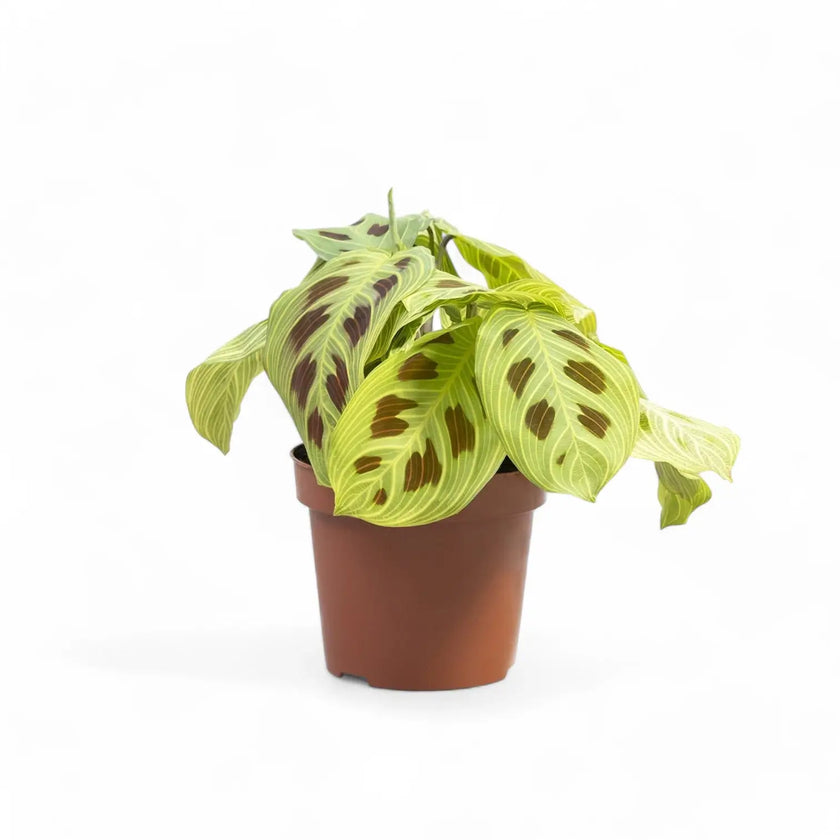
Prayer Plants
Prayer plants are grown for patterned leaves and daily movement rather than size. Most stay low and spreading, with foliage that lifts or folds through the day thanks to a joint-like pulvinus near the leaf blade.
Maranta, Goeppertia, Ctenanthe, and Stromanthe are striking when close-up leaf detail matters as much as overall shape. With steady moisture, gentle light and decent humidity, they bring movement and pattern into a room without asking for much floor space.

About Our Filters
Filters help you narrow things down fast and without guessing. We put a lot of time and effort into keeping filter values consistent across the shop by cross-checking references and validating them against real-world indoor growing and handling.
Use them as guidance, not guarantees. Homes vary a lot, so for the full context (and any exceptions), open the product page and read the description.
How filtering works
- Filters stack: each selection narrows results.
- Multiple picks in one filter are usually either/or within that filter.
- Undo anytime: click a selected option again (or clear filters).
Safety
- Non-toxic: not known for relevant chemical toxicity for common pets (chewing can still cause irritation).
- Non-toxic & Pet Friendly: stricter shortlist that also avoids many physical hazards like spines, sharp tips, thorns, and bristles.
Common care filters
- Light level: Low indirect → Full sun/direct.
- Water Needs: Low / Medium / High.
- Humidity Level: Normal (40–50%) / Moist (50–60%) / Humid (60–80%+).
Growth & size
- Growth Habit: climbing, trailing, crawling, upright, self-heading, clumping, rosette.
- Needs support? none / optional / needed.
- Delivered size: pot size + plant height at shipping.
- Max size indoors: realistic long-term height + spread indoors.
Looks & botanical browsing
- Leaf Shape & Size + Foliage Colour: quick visual categories.
- Plant Type / Genus / Family: browse by broad group or taxonomy.
If you want to see the references we use, Plant Care Resources is simply a curated list of source links (POWO, Kew, and more).
Sort by
Filters
Marantaceae
Prayer Plants
Quick Overview
Prayer plants-quick snapshot
- Look & behaviour: Striped, veined leaves that fold and shift between day and night.
- Light: Bright, soft light; long-term gloom or harsh beams both fade pattern and vigour.
- Moisture: Keep mix lightly moist; full dry-outs quickly mean curled, crispy foliage.
- Sensitivity: Fine roots dislike heavy, compact soil and erratic “soak then ignore” watering.
- Best for: Growers who enjoy daily changes and do not mind checking substrate regularly.
Botanical Profile
The common name usually refers to members of Marantaceae such as Maranta, Goeppertia and Ctenanthe. Many have visible day-night leaf movement driven by the pulvinus at the leaf base.
Details & Care
Prayer Plants: patterned Marantaceae with moving foliage
Prayer plants bring pattern and movement into a collection. Veins, midribs and colour fields shift as leaves change position over the day, so this group never looks static, especially at close range.
Here you mainly see Marantaceae such as Maranta, Goeppertia and Ctenanthe. Growth stays low and creeping or gently arching rather than tall, with a medium learning curve: they hold up best with stable moisture in a reasonably bright spot without direct sun, and they show stress quickly if conditions stay too dry or too dark. Common questions on watering, humidity and troubleshooting are covered in our Calathea Care Guide, which applies broadly to this family.
- Signature effect: Compact plants with animated foliage and clear, graphic patterning.
- Growth style: Spreading clumps and short runners that fill trays, shelves and low planters.
- Care profile: Prefer steady, moderate watering rather than strict “bone-dry, then soak” cycles.
- Good match if you: Enjoy watching small daily changes and are happy to pay attention to watering.
- Maybe not for you if: You often forget to water or only have very harsh sun or very dim corners available.
Choose Prayer Plants when you want low, patterned foliage with visible daily movement and are prepared to give watering more than just occasional attention.
Frequently Asked Questions About Prayer Plants
Why are they called prayer plants?
The name comes from nyctinasty, the daily leaf movement that lifts or folds the leaves at night and lowers them again by day. In houseplant use, “prayer plants” usually means Maranta and other Marantaceae commonly sold alongside it, such as Goeppertia, Ctenanthe and Stromanthe.
Do prayer plants like low light?
They tolerate lower indirect light better than harsh sun, but most grow best in bright indirect light. Too little light slows growth and can make patterns look duller, while direct sun can fade or scorch the leaves.
Why do prayer-plant leaves get brown edges?
Brown edges usually point to dry air, inconsistent moisture, or minerals and fluoride in the water. Once an edge has browned it will not turn green again, so the real fix is improving conditions for the next leaves.
Do prayer plants need filtered or rainwater?
Often, yes. Many prayer plants are sensitive to fluoride, chlorine and mineral build-up, so filtered, distilled or rainwater can noticeably reduce brown tips and edge burn. If your tap water is soft and the plant is growing cleanly, you may not need to change anything.
Are prayer plants safe around pets?
Most houseplants sold as prayer plants are considered non-toxic to cats and dogs. It is still worth checking the exact plant name if pet safety is a deciding factor, especially because common names get used loosely in retail.
Limited discounts, extras, and bundle deals for subscribers.
Get points with every order to redeem them for discounts.
Give your friends 10 € off and get 200 Foliage Points.
Use your 10% code on plants when you're ready to order.