

Maranta
Maranta stays low but busy: patterned leaves lift and lower through the day and give clear feedback about light, water and humidity. Indoors it sits between forgiving and fussy-easier than the most delicate Goeppertia, still uninterested in deep shade, hard water and long dry spells.
That makes Maranta especially rewarding at close range. It brings texture and movement to shelves and tables in moderate light, away from hard sun on the leaves, and it usually looks best when the substrate stays lightly moist and airy rather than cycling between drought and saturation. If your water is very hard, softer water often makes a visible difference over time, especially on leaf edges.

About Our Filters
Filters help you narrow things down fast and without guessing. We put a lot of time and effort into keeping filter values consistent across the shop by cross-checking references and validating them against real-world indoor growing and handling.
Use them as guidance, not guarantees. Homes vary a lot, so for the full context (and any exceptions), open the product page and read the description.
How filtering works
- Filters stack: each selection narrows results.
- Multiple picks in one filter are usually either/or within that filter.
- Undo anytime: click a selected option again (or clear filters).
Safety
- Non-toxic: not known for relevant chemical toxicity for common pets (chewing can still cause irritation).
- Non-toxic & Pet Friendly: stricter shortlist that also avoids many physical hazards like spines, sharp tips, thorns, and bristles.
Common care filters
- Light level: Low indirect → Full sun/direct.
- Water Needs: Low / Medium / High.
- Humidity Level: Normal (40–50%) / Moist (50–60%) / Humid (60–80%+).
Growth & size
- Growth Habit: climbing, trailing, crawling, upright, self-heading, clumping, rosette.
- Needs support? none / optional / needed.
- Delivered size: pot size + plant height at shipping.
- Max size indoors: realistic long-term height + spread indoors.
Looks & botanical browsing
- Leaf Shape & Size + Foliage Colour: quick visual categories.
- Plant Type / Genus / Family: browse by broad group or taxonomy.
If you want to see the references we use, Plant Care Resources is simply a curated list of source links (POWO, Kew, and more).
Sort by
Filters


Maranta cristata 'Intense'
Sold out


Maranta leuconeura 'Cat moustache' ('Exclusive Dark')
Regular price
€21,50


Maranta leuconeura 'Fascinator' ('Tricolor', 'Red Stripe')
Regular price
From €8,00


Maranta leuconeura 'Kerchoveana variegata' ('Beauty Kim', 'Fiesta')
Regular price
€17,25


Maranta leuconeura 'Lemon Lime'
Regular price
€16,75

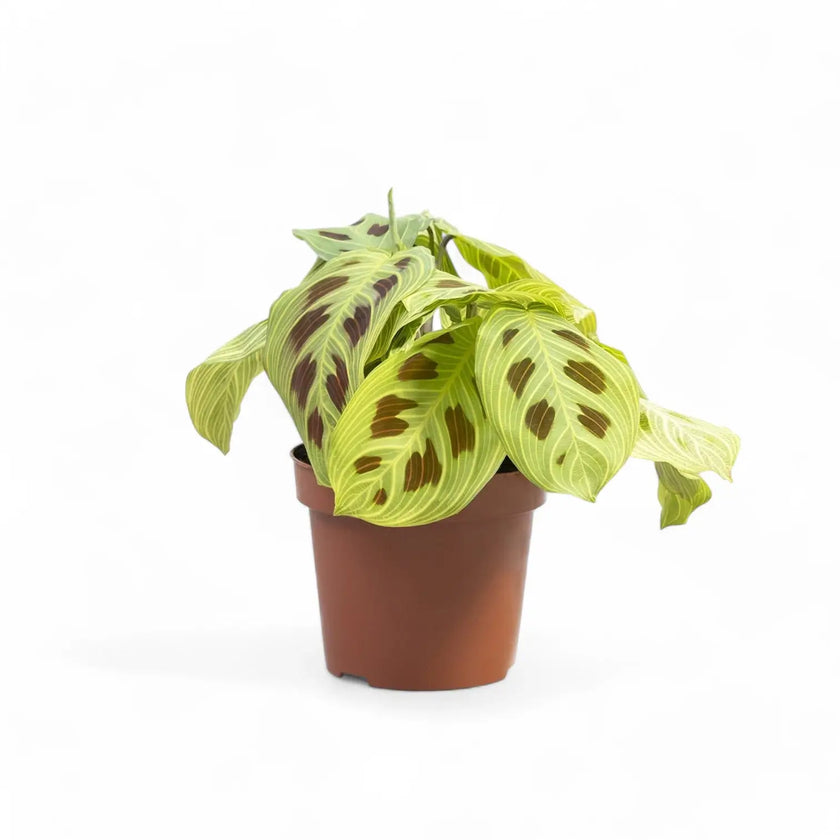
Maranta leuconeura 'Light Veins' ('Fantasy')
Regular price
€18,50


Maranta leuconeura 'Silver Band' (Exclusive grey')
Regular price
€17,25


Plant Set: Maranta Collection
Regular price
€54,00
Marantaceae
Maranta
Quick Overview
Maranta (prayer plants) - fine-pattern care
- Look: low mounds of patterned leaves that lift and lower daily; great for close viewing on shelves and desks.
- Light: bright shade to low-medium light; too little fades markings, direct sun burns broad surfaces.
- Moisture: keep mix lightly moist, letting only the top centimetre dry; full drought or heavy swamp both damage roots.
- Water quality: responds better to soft or filtered water; very hard tap water often shows as brown tips.
- Humidity: performs best with moderate to high humidity and gentle airflow to prevent edges crisping.
- Care tip: avoid cold floors and draughts; chilled, wet soil is a common cause of sluggish, unhappy plants.
Botanical Profile
Maranta (Prayer Plants) - botanical profile for rhizomatous Marantaceae
Maranta is a genus of rhizomatous herbs in Marantaceae, named by Linnaeus in honour of Italian botanist Bartolomeo Maranta. Around 40-50 species are recognised, all with underground rhizomes and evergreen leaves that fold upwards at night, giving rise to the prayer plant name. Maranta leuconeura and its cultivars are among the best-known foliage houseplants in this group.
- Order: Zingiberales
- Family: Marantaceae
- Tribe: Maranteae
- Genus: Maranta L.
- Type species: Maranta arundinacea L.
- Chromosomes: Chromosome counts fall within ranges typical for Marantaceae, with diploid numbers in the low- to mid-20s and polyploid series in some species.
Range & habitat: Maranta is native to tropical Central and South America and the West Indies. Species grow on forest floors, stream margins and clearings with high humidity and warm, stable temperatures, often in deep leaf litter over well-drained but moisture-retentive soils.
- Life form: Low, clump-forming perennials with creeping rhizomes that periodically branch and form new rosettes, producing dense mats under favourable conditions.
- Leaf attachment: Leaves borne on slender petioles with pulvini at the blade base, enabling pronounced diurnal movements between day and night positions.
- Leaf size: Many species have blades 10-25 cm long, typically elliptic to ovate; a few taxa remain smaller but retain the same general architecture.
- Texture & colour: Smooth, often glossy laminae with distinct patterns such as herringbone veins or contrasting midribs; abaxial leaf surfaces frequently tinged purple or maroon.
- Notable adaptation: Nyctinasty driven by pulvini adjusts leaf angle to changing light and humidity, enhancing light interception by day and reducing exposure or dew-shedding demands overnight.
Inflorescence & fruit: Inflorescences are slender spikes or panicles with small, often white, pale purple or yellow flowers; petaloid staminodes contribute to floral display more than the true petals. Fruits are small capsules with few seeds, while many cultivated clones are propagated clonally via division for leaf trait stability.
Details & Care
Maranta: responsive prayer plants and how to choose them
Why Maranta feels unusually “alive” in an indoor collection
Maranta combines bold patterning with constant, quiet movement. Leaves shift position over the day, resting flatter when light is strongest and lifting into a loose bundle once it gets dark. That daily rhythm, together with strong veining or spotting, gives Maranta a presence that feels more animated than many static foliage plants.
Care sits between “easy” and “high maintenance”. It needs more attention than tough succulents, but far less crisis management than the most temperamental tropicals. Once light, moisture and humidity are roughly in range, Maranta usually settles into a predictable cycle of new leaves and steady growth. For a broader prayer-plant context, compare notes with our Calathea care guide.
Maranta and your conditions-who this genus suits
- Fits well when: you can offer bright, indirect light, are happy to check substrate instead of watering by calendar, and do not mind boosting humidity a little during heating season.
- Less ideal if: windows are small or deeply shaded, indoor air is very dry for long stretches and you prefer frequent “just in case” watering that keeps pots continuously wet.
- Good to know: Maranta can look dramatic when stressed, but with healthy roots and stable conditions it often recovers faster than its reputation suggests. If you need a mindset reset, read “Rethink houseplant care” first.
Maranta origins-Brazilian forest-floor context
Many Maranta species originate in warm, humid forests of Central and South America, with a strong presence in Brazilian habitats. Plants live low to the ground in leaf litter, moss and loose organic debris beneath taller vegetation. Light reaches them in a softened, filtered way; air holds moisture, and excess water drains away rather than pooling around roots.
Indoors, this background points you towards bright but diffused light, a substrate that can hold moisture without turning to sludge and a watering rhythm that avoids both deep drought and waterlogged soil. Thinking of Maranta as a forest-floor plant rather than a semi-succulent makes most care decisions much easier and ties in neatly with the principles in our ultimate substrate guide.
Light quality for Maranta pattern, colour and leaf posture
Maranta shows its best colour and patterning in strong, indirect light. A place near a window with soft morning sun, or slightly back from a stronger south- or west-facing window, suits most forms well. Under harsh direct midday sun, leaves feel hot, colours wash out and crisp, pale or brown areas appear on exposed sections.
In genuinely low light, stems stretch, markings fade and new leaves appear more slowly. Plants parked several metres from any window for months often look flat and tired, with less obvious nightly folding. If you are uncertain if a position is bright enough, compare your conditions with the photos and descriptions in our bright-indirect light guide and the nuance in our low-light explainer instead of guessing.
Signs of a good match include firm leaves with clear patterns, steady growth and the characteristic night fold, without tight stress curls during the day. If you are still juggling where to put what, our window orientation guide can help map your space.
Moisture management and substrate structure for Maranta
Maranta prefers consistently gentle moisture around its roots. Let the upper 2-3 cm of substrate dry to the touch before watering again, while the lower layer remains faintly cool rather than completely dry. Allowing the whole pot to reach a rock-hard state leads to tight leaf curls, limp stems and brown patches that do not reverse.
A suitable mix makes this easier. Start with a peat-free indoor potting base and blend in a clear portion of bark, perlite or pumice. Fine material holds water, while the chunkier fraction keeps air gaps open. Dense, compacted soil at the root zone raises the risk of rot and makes timing watering much harder. The principles in our drainage vs aeration guide explain why.
Bottom watering can work well for Maranta if handled carefully. Follow the steps in our bottom watering guide for houseplants, let the pot soak only until the mix is evenly moist, then tip away any remaining water so roots are not left standing in it.
Water quality matters too. Hard, lime-rich tap water often leaves pale crusts on substrate and pot edges and can contribute to brown margins over time. Where possible, use rainwater, filtered water or naturally softer tap water and give the pot an occasional thorough flush to wash out accumulated salts. For more detail, see the water-related pieces under our watering tag.
Temperature, humidity and airflow sweet spot for Maranta
Maranta is most comfortable at typical warm indoor temperatures of roughly 18-27 °C. Brief dips below that are usually tolerated if the mix is only lightly moist, but extended periods below about 15 °C, especially with wet roots, can damage rhizomes and leave foliage limp and dull. Cold air leaking around windows or doors is a frequent hidden trigger; our winter care guide covers how to buffer plants from those drafts.
Humidity around 50-70 % keeps Maranta noticeably happier. Dry air from radiators or underfloor heating is one of the most common reasons for brown tips, rolled edges and a general look of fatigue even when watering is sensible. Grouping plants, using a small humidifier nearby or placing Maranta in a cabinet with gentle airflow all change conditions far more effectively than occasional misting. For realistic approaches, see our humidity guide and, if you are tempted to rely solely on spray bottles, the caveats in our misting guide.
Some air movement is helpful as long as it is not a cold blast. Completely still air lets moisture linger on leaves and crowns, encouraging fungal issues, while strong drafts dehydrate foliage. Aim for a soft overall air circulation in the room rather than a jet aimed at the plant.
Maranta growth pattern and shaping options
Maranta grows from creeping rhizomes that send up short stems tipped with single leaves. Over time, this creates a low mound that may eventually spill slightly over the pot edge in some varieties. Older leaves age out near the base; removing them once they are tired clears space and lets fresh foliage take the lead visually.
Shaping is straightforward. Cutting back a longer stem above a healthy node usually triggers new shoots from lower down, which thickens the plant. Stem pieces with a few nodes can be rooted in water or directly into moist substrate to build a fuller clump. Because Maranta stores reserves in its rhizomes, it often responds well once the root system is kept healthy. If you plan to propagate, the basics in our propagation guide apply nicely.
Fertiliser should be used gently. A balanced product at reduced strength during active growth phases is usually enough. Ease off when growth slows, the mix stays wet for longer than normal or roots are recovering from problems. A breathable substrate and functioning roots matter more for long-term health than any specific feed formula; our fertilising basics guide goes through this logic.
Maranta and household safety with kids or pets
Maranta is generally regarded as non-toxic to people and most common pets, which makes it a popular choice for “family-safe” foliage. Even so, chewing large amounts of any plant can irritate digestion, so it is still sensible to discourage nibbling and to keep pots out of reach of very determined grazers. For more ideas in the same direction, see our cat-safe houseplants guide.
Routine handling is simple. Wiping dust from leaves improves both appearance and photosynthesis and gives you a chance to spot pests early. After pruning or removing old leaves, wash your hands as a basic hygiene step and avoid touching your eyes while handling substrate or sap. If you notice sugary droplets on leaves, cross-check with our guttation explainer to see if it is normal guttation or a sign of pests.
Maranta settling-in period after shipping
Time in a box, temperature swings and low airflow often leave Maranta a little out of sorts on arrival. Some leaves may curl more than usual, a few older ones can yellow from the base, and edges may show small creases or scuffs from packaging. These marks are cosmetic; new growth will reflect the conditions you provide now.
Unpack gently, clear loose debris from the substrate surface and place the plant in bright, indirect light away from hot glass and cold drafts. Check moisture deeper in the pot with a finger or wooden stick; the upper layer can look dry while the lower part is still moist. Only water if the mix is drying through, and delay repotting unless you see clear signs of rot or heavily degraded substrate. For the full logic behind this phase, see our acclimatisation guide.
Over the next weeks, look for firmer leaf posture, fresh leaves unfurling and regular night folding as signs that Maranta is settling in. Once growth is steady, you can fine-tune placement or do light pruning to match your preferred shape.
Maranta troubleshooting-decoding common symptoms
- Brown, crispy tips and edges: usually a mix of dry air, uneven watering or mineral build-up from hard water. Increase humidity moderately, switch to softer water if you can, keep the mix gently moist rather than swinging between extremes and trim damaged areas if they bother you. For more detail, our guide to brown leaf tips helps narrow down causes.
- Tight daytime curls instead of gentle night folding: indicates stress rather than normal movement. Check for underwatering, harsh direct sun or sudden cold drafts, then move the plant to softer light and re-establish more even moisture.
- Yellowing lower leaves with heavy, wet substrate: classic sign of overwatering in a compact mix. Remove the worst-affected leaves, allow the pot to dry to at least mid-depth, then repot into a looser blend if needed and trim any black, mushy roots you find. The step-by-step is laid out in our root rot treatment guide.
- Faded patterns and sluggish growth: most often linked to insufficient light rather than lack of fertiliser. Shift the plant closer to a suitable window while keeping it out of harsh midday sun; only think about increasing feed once light has been improved.
- Fine webbing and stippled, dull leaves: typical spider mite damage. Rinse foliage gently, nudge humidity higher, improve airflow and begin an appropriate treatment early before populations build up. For recognition and options, see our spider mite guide.
Linked blogs: bright-indirect-light-houseplants, low-light-houseplants-explained, window-orientations-houseplants-guide, houseplant-substrates-ultimate-guide, drainage-vs-aeration-houseplants, bottom-watering-houseplants-guide, brown-leaf-tips-houseplants-fixes, humidity-for-houseplants-guide, misting-houseplants-guide, houseplant-acclimatization-guide, root-rot-houseplants-treatment, spider-mites-houseplants-guide, calathea-care-guide, rethink-houseplant-care, houseplants-safe-for-cats-guide, guttation-plants-explained, fertilizing-houseplants-beginner-guide, propagation-houseplants-guide, winter-houseplant-care-guide, stomata-plant-function-explained
Back to top Ready to give prayer plants a proper stage? Pick your favourite Maranta from the selection above and add it to your cart ↑
Frequently Asked Questions About Maranta
Why do Maranta leaves move at night?
That movement is normal. Maranta are known as prayer plants because the leaves lift or fold upward in lower light and at night, then settle again during the day.
What light does Maranta need indoors?
Bright indirect light is usually the best fit. Maranta cope with softer light better than many tropical houseplants, but direct sun can scorch the leaves and flatten the pattern.
How should I water Maranta?
Water when roughly the top 10–20% of the pot has dried. In cooler or darker periods, let closer to the top 20–25% dry before watering again. The root zone should stay lightly and evenly moist, not soggy and not allowed to dry right through.
Why do Maranta leaves get brown edges or start curling?
Usually because of dry air, inconsistent watering, or minerals in the water source. Maranta often show stress first at the tips and edges, so crisp margins usually mean the conditions are running a bit too harsh.
Are Maranta safe around pets?
Yes, Maranta are generally treated as non-toxic to cats and dogs, which is one reason they are popular in pet-friendly homes.


Limited discounts, extras, and bundle deals for subscribers.
Get points with every order to redeem them for discounts.
Give your friends 10 € off and get 200 Foliage Points.
Use your 10% code on plants when you're ready to order.