

Polyscias
Polyscias, often sold as aralias, behaves like a miniature indoor tree or shrub with layered foliage and woody stems. Bright filtered light, warm air and even moisture in a structured mix bring out its long-term sculptural presence, and it responds well to shaping when you want a cleaner outline.
It is a strong choice when you want woody structure but a very large Ficus or palm would feel too much. In the right light, Polyscias gives you a refined indoor-tree silhouette that never feels blunt and sits comfortably in bright rooms where a 60 to 180 cm plant has space to read properly.

About Our Filters
Filters help you narrow things down fast and without guessing. We put a lot of time and effort into keeping filter values consistent across the shop by cross-checking references and validating them against real-world indoor growing and handling.
Use them as guidance, not guarantees. Homes vary a lot, so for the full context (and any exceptions), open the product page and read the description.
How filtering works
- Filters stack: each selection narrows results.
- Multiple picks in one filter are usually either/or within that filter.
- Undo anytime: click a selected option again (or clear filters).
Safety
- Non-toxic: not known for relevant chemical toxicity for common pets (chewing can still cause irritation).
- Non-toxic & Pet Friendly: stricter shortlist that also avoids many physical hazards like spines, sharp tips, thorns, and bristles.
Common care filters
- Light level: Low indirect → Full sun/direct.
- Water Needs: Low / Medium / High.
- Humidity Level: Normal (40–50%) / Moist (50–60%) / Humid (60–80%+).
Growth & size
- Growth Habit: climbing, trailing, crawling, upright, self-heading, clumping, rosette.
- Needs support? none / optional / needed.
- Delivered size: pot size + plant height at shipping.
- Max size indoors: realistic long-term height + spread indoors.
Looks & botanical browsing
- Leaf Shape & Size + Foliage Colour: quick visual categories.
- Plant Type / Genus / Family: browse by broad group or taxonomy.
If you want to see the references we use, Plant Care Resources is simply a curated list of source links (POWO, Kew, and more).
Sort by
Filters


Polyscias filicifolia
Sold out


Polyscias fruticosa 'Ming' ('Ming Aralia')
Regular price
€115,50


Polyscias guilfoylei 'Roble'
Sold out


Polyscias pinnata ‘Green Lemon’
Sold out

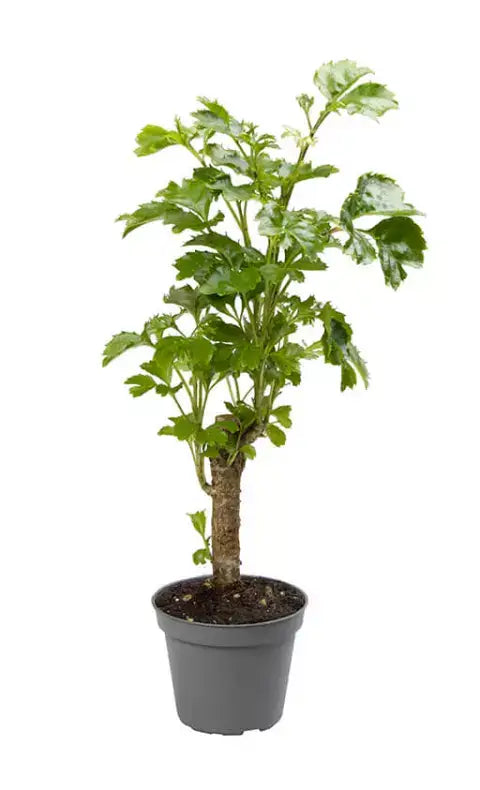
Polyscias scutellaria 'Butterfly'
Sold out


Polyscias scutellaria 'Fabian'
Regular price
From €24,00
Araliaceae
Polyscias
Quick Overview
Polyscias (aralias) - compact indoor “trees”
- Habit: woody shrub or small tree with layered foliage; makes a good vertical accent for bright rooms.
- Light: medium to bright, indirect light; too little light causes bare stems and sparse crowns.
- Watering: likes evenly moist but not waterlogged mix; cold, wet substrate leads to sudden leaf drop.
- Substrate: responds well to structured indoor compost with extra drainage; avoid compact, constantly soggy soil.
- Climate: prefers warm, draft-free rooms with moderate humidity; dislikes temperature swings near doors and windows.
- Toxicity: can cause digestive upset if eaten; position away from pets and small children.
Botanical Profile
Polyscias: botanical profile for aralia-type foliage shrubs
Polyscias is a woody genus in Araliaceae, originally described by J. R. and G. Forster and later recircumscribed to include several related genera. The name combines Greek “poly” (many) and “skia” (shade or canopy), alluding to the multi-divided foliage that forms an umbrella-like crown. Modern treatments recognise roughly 150-180 accepted species, making Polyscias one of the largest genera in the ivy family and an important source of ornamental aralia shrubs.
- Order: Apiales
- Family: Araliaceae
- Tribe: Aralieae
- Genus: Polyscias J.R.Forst. & G.Forst.
- Type species: Polyscias nodosa (Blume) Seem.
- Chromosomes: Somatic numbers commonly around 2n ≈ 48-50, with several polyploid series inferred from karyological work on selected species.
Range & habitat: Polyscias is mainly Old World tropical, extending from Africa through Madagascar and the western Indian Ocean islands across tropical Asia and Malesia to Australia and the Pacific islands. Species inhabit lowland and montane rainforests, cloud forests, coastal scrub and secondary vegetation, often as understorey or subcanopy trees and shrubs on well-drained but reasonably moist soils.
- Life form: Evergreen shrubs and small to medium trees, frequently multi-stemmed, with potential to form dense, intricate crowns in humid climates.
- Leaf attachment: Leaves commonly alternate and highly divided (pinnate to tripinnate), giving a finely textured, fern-like or lacey canopy; some species have broader, simple or lobed leaflets.
- Leaf size: Terminal leaf segments are often 3-15 cm long, but entire compound leaves can reach several tens of centimetres, especially in tree-sized species.
- Texture & colour: Leathery to slightly fleshy leaflets, usually glossy green but in cultivars often variegated with cream, yellow, lime or bronze; margins may be serrate, lobed or entire.
- Notable adaptation: Flexible, finely divided crowns dissipate wind load and intercept dappled light efficiently, which suits exposed coastal sites and layered tropical canopies alike.
Inflorescence & fruit: Polyscias produces terminal or axillary panicles or racemes of small, often greenish to whitish flowers typical of Araliaceae. The fruits are usually small drupes or berries with several seeds, dispersed by birds and other frugivores that forage in forest canopies and edges.
Details & Care
Polyscias: sculptural indoor Aralia trees for bright rooms
Polyscias: sculptural “aralias” for modern interiors
Polyscias is a genus of small trees and shrubs in the Araliaceae family, native from tropical Africa across Asia to the Pacific islands. Its name means “many-shaded”, a reference to the dense, layered foliage that makes these plants look like miniature indoor trees. Well-known species and cultivars include Polyscias fruticosa (Ming aralia), Polyscias scutellaria ‘Fabian’ (dinner plate aralia), Polyscias balfouriana and Polyscias guilfoylei, many of which are valued for their finely divided or boldly variegated leaves.
As houseplants, Polyscias are all about structure and texture. Thick, often gnarled trunks carry tiers of foliage that can be clipped into lacy, cloud-like crowns or allowed to keep a looser, more natural outline. They stay relatively compact for an “indoor tree”, making them ideal for bright living rooms, home offices and corners that need height without overwhelming the space.
Is Polyscias a good match for your space?
- Where Polyscias thrives: warm, steady rooms with medium to bright, filtered light, space for a 60-180 cm plant, and an owner who is happy to water thoughtfully rather than on autopilot.
- More demanding when: your home has very low light, cold draughts, or very dry air, or if you tend to water heavily and leave pots wet-Polyscias is sensitive to cold, stagnant soil around its roots.
- Before you choose a Polyscias: consider the growth habit. Upright, columnar types like Polyscias fruticosa make elegant, narrow “indoor trees”, while broader, dinner-plate forms such as Polyscias scutellaria ‘Fabian’ read as compact, branching shrubs suited to side tables or floor planters.
Polyscias in the wild-tropical shrubs from Africa to the Pacific
Polyscias is a pantropical genus with its natural range stretching from tropical Africa through Madagascar and Asia to the Pacific islands. In nature, most species grow as evergreen shrubs or small trees in warm, frost-free climates, often in the understory or at the edges of forests where they receive bright but filtered light. They develop woody stems and branches with pinnate or deeply divided leaves, sometimes forming natural thickets or small groves.
These plants are adapted to consistently warm temperatures, good ambient humidity and soils that hold moisture but drain freely. Understanding this background helps when you grow Polyscias indoors: they prefer stable warmth, protection from harsh midday sun, and a potting mix that is neither waterlogged nor baked dry.
Polyscias light & placement-bright but not blistering
Polyscias generally prefer a bright position out of direct midday sun. A spot near an east- or west-facing window, or a few steps back from a south-facing window with sheer curtains, usually provides the right balance of light and protection. In this light range, new leaves emerge with good colour and the plant maintains a dense, bushy silhouette. If you need a reality check on what “bright-indirect” actually looks like in your home, compare your room to our bright-indirect light guide.
Too little light leads to long, bare sections of stem, sparse foliage and faded variegation. Too much direct, intense sun, especially through glass, can scorch leaf edges and cause pale, dry patches, particularly on variegated or finely cut cultivars.
Polyscias roots, watering & soil-evenly moist, never waterlogged
Polyscias develop woody, branching root systems that appreciate both moisture and air. In a container, they resent sitting in cold, saturated compost or being allowed to dry out rock hard. Use a high-quality, peat-free indoor potting mix and lighten it with fine bark, coco chips and a mineral component such as pumice or perlite so water can move through rather than stagnate. Heavy ceramic or terracotta pots suit their top-heavy, tree-like habit and allow excess moisture to evaporate through the sides.
Instead of watering to a strict calendar, watch the mix and the weight of the pot. Let the top 2-3 cm of the substrate dry so it looks and feels dry and the container feels noticeably lighter in your hand. When you water, do it slowly and thoroughly until excess flows from the drainage holes, then empty any saucer so the roots are not standing in water. Chronic saturation in a dense mix leads to root rot and yellowing or shedding leaves; letting the plant swing from soaked to bone dry shows up as limp, curling foliage and brittle stems.
Polyscias are not heavy feeders, but they do appreciate a modest nutrient supply during active growth. A balanced, diluted houseplant fertiliser every four to six weeks in spring and summer is usually sufficient. Apply it only to already moist soil and avoid strong feeds on very dry or stressed plants-excess salts combined with low moisture can burn roots. For a deeper understanding of how watering, pot size and substrate work together, see our complete watering guide for houseplants and adjust those principles to your Polyscias and its container.
Polyscias & your home climate
Polyscias is a creature of the tropics and prefers the same steady warmth indoors. Temperatures between about 18 and 27 °C suit most cultivated forms. Brief dips a little lower are usually tolerated if the mix is on the dry side, but prolonged exposure below roughly 15 °C, or cold draughts across damp roots, can trigger leaf drop and dieback of tender tips.
Humidity plays a significant role in how well Polyscias perform. Medium to high relative humidity-around 50-70 % - helps keep leaves supple and prevents the fine margins from browning. In homes with very dry air, especially in winter, you may see leaves yellowing and falling from the lower stems. Grouping plants together, running a small humidifier nearby or placing Polyscias away from heaters and door draughts are practical ways to improve its microclimate without resorting to constant misting or standing the pot in trays of water. For realistic humidity ranges and options, see our humidity guide for houseplants.
Polyscias growth, pruning & styling indoors
Most Polyscias grown as houseplants form upright, branching stems that can be trained as small indoor trees or kept pruned into compact, dense shapes. New shoots emerge from buds along the stems; regular light trimming encourages bushiness and helps maintain an attractive outline. You can remove leggy or crossing branches back to a leaf node, and even older, woody stems will often reshoot if there is healthy tissue below the cut.
Because Polyscias respond well to pruning and have naturally woody trunks, they are also popular for bonsai-style training. When shaping, make several smaller cuts over time rather than removing a large quantity of foliage at once-this reduces stress and gives the plant time to adjust. Check the root ball every couple of years: if roots are tightly circling the pot or the mix has compacted and stays wet for days, it is time to move your Polyscias into a slightly larger container and refresh the soil.
Polyscias and pet safety
Members of the Araliaceae, including Polyscias, often contain saponins and other compounds that can irritate the digestive tract if eaten. While serious poisoning from ornamental Polyscias is uncommon, leaves and stems are not intended as food and may cause mild stomach upset or mouth irritation in pets and small children.
As a precaution, position Polyscias out of easy reach of cats, dogs and curious toddlers, and promptly clear away any fallen leaves. When pruning or repotting, basic plant-handling hygiene-using clean tools and washing hands afterwards-is normally sufficient; people with very sensitive skin may prefer to wear gloves if they notice any irritation from the sap.
What you may notice when your Polyscias arrives
Potted shrubs like Polyscias can look a little ruffled after shipping. It is normal to see a few yellowing or curled leaves, minor breakage on outer twigs or some leaf drop in the first week as the plant adjusts to its new environment. These are usually temporary stress responses rather than signs of a long-term problem.
After unboxing, remove any loose or clearly damaged leaves and branches and tidy the soil surface. Place your Polyscias straight into the warm, bright but not sun-scorched spot you have chosen, instead of moving it from room to room. Check the moisture level a couple of centimetres below the surface: if the mix feels very dry and the pot is light, water thoroughly and allow the excess to drain; if it is still evenly moist, wait a few days before watering. Avoid repotting immediately unless the root ball is unstable or the mix is clearly degraded. Over the following weeks, look for firm new leaves and steady extension of shoots-these are the best indications that your Polyscias is settling in. For more on helping new arrivals adjust, see our houseplant acclimatisation guide.
Polyscias troubleshooting-reading the signs
- Sudden leaf drop from the lower stems: often linked to a change in position, cold draughts or a prolonged spell of wet, cold soil. Move the plant to a more stable, warm spot, check and improve drainage, and let the mix dry a little more between waterings.
- Brown, crispy leaf edges or tips: usually a combination of low humidity, hot dry air or irregular watering. Shift Polyscias away from radiators and other heat sources, improve background humidity and aim for a more even watering rhythm.
- Pale, sparse foliage and long gaps between leaves: a sign that light levels are too low. Move the plant closer to a window or provide gentle supplementary lighting so it receives several hours of bright, indirect light each day.
- Soft, blackened roots or a sour smell from the pot: indicate root rot from waterlogged, air-poor compost. Unpot the plant, trim away all mushy roots, repot into a fresh, airy mix with good drainage and water sparingly until new growth resumes. Our root-rot guide walks through this in detail.
- Sticky residue, sooty mould or distorted new leaves: often caused by sap-sucking pests such as scale, mealybugs or aphids. Inspect stems and leaf undersides, remove heavily infested parts and follow a consistent treatment plan before pests spread to other plants. For identification and options, see our guides on scale insects and mealybugs.
Back to top and choose the Polyscias that suits your room height, your light and the kind of indoor-tree silhouette you want ↑
Frequently Asked Questions About Polyscias
What does Polyscias usually mean as a houseplant?
Indoors, Polyscias usually means woody tropical aralias such as Ming Aralia and related foliage forms, not every species in the genus.
What light does Polyscias need indoors?
Bright indirect light is the safest baseline. Some forms can handle a little gentle morning sun, but prolonged low light usually leads to thinner growth and easier leaf drop.
How often should I water Polyscias?
Water when roughly the top 25–40% of the pot has dried. In cooler or dimmer conditions, let it dry a bit further before watering again.
Why does Polyscias drop leaves after being moved or stressed?
Usually because conditions changed too abruptly. Polyscias reacts badly to sudden shifts in light, temperature, humidity, or watering rhythm, so consistency matters more here than with tougher beginner houseplants.
Can Polyscias be pruned to stay compact indoors?
Yes. Tip-pruning usually encourages denser branching and helps keep it fuller instead of tall and bare.


Limited discounts, extras, and bundle deals for subscribers.
Get points with every order to redeem them for discounts.
Give your friends 10 € off and get 200 Foliage Points.
Use your 10% code on plants when you're ready to order.